1
Why the Sermorelin editorials disagree
A hopeful argument about hormone rhythms. A warning about treating aging. The medicinal case gets more interesting when these questions meet. 1

2006: the physiological case
Walker’s 2006 editorial makes a case for Sermorelin through its physiology: it prompts the pituitary to release the body’s own growth hormone, retaining the pulses and feedback that regulate that release. He suggests this could be a better approach to adult-onset growth hormone insufficiency than supplying recombinant growth hormone.
That preference has some force for me. Leaving the body’s regulation involved has an appeal that a bare promise of higher hormone levels lacks. The word medicinal, though, asks for something further: an improvement worth the burdens and uncertainties of treatment. An elegant mechanism gives the argument a beginning. I’m less persuaded that it gives the argument an ending.
2008: the aging caution
Blackman’s editorial on secretagogues and the effects of aging asks a broader clinical question and judges the evidence insufficient to justify that use. A secretagogue is simply a substance that prompts a gland to release a hormone; the name describes an action, leaving the value of that action to be established.
The two editorials pull in different directions partly because they ask different questions. A preference among ways to raise growth hormone can coexist with serious doubt about treating aging by raising it at all. I give the physiological argument credit, while siding with the demand for demonstrated benefit. That tension is the reason for Medicinal Sermorelin.
The clinical chronology
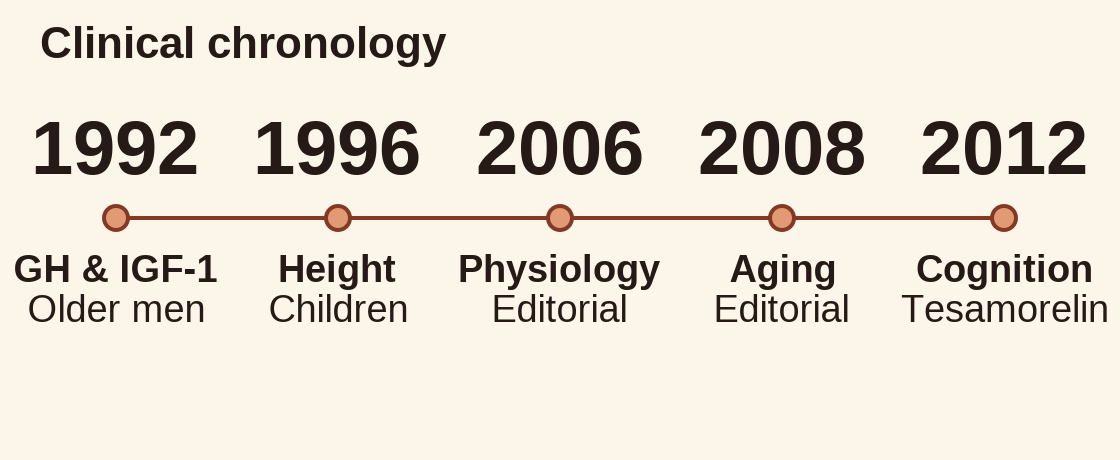
Before either editorial, a study in healthy older men raised GH and IGF-1 over 14 days, and a multicenter childhood trial recorded faster height growth. Later, a cognition trial in older adults tested tesamorelin, a stabilized relative of Sermorelin. These experiments answer quite different questions, even when their introductions sound familiar.
The chronology helps me resist treating the editorials as the finish of the subject. The clinical work continues, with changes in the molecule, the participants and the outcome being sought.
Sermorelin mechanism of action
Sermorelin copies the first 29 amino acids of the 44-residue GHRH hormone. This short fragment retains full activity at the GHRH receptor on the pituitary’s growth-hormone-producing cells. Receptor activation raises cyclic AMP inside those cells, promoting growth hormone synthesis and release; GH then stimulates IGF-1 production, principally in the liver.
Somatostatin and IGF-1 provide feedback, and human experiments also demonstrate growth hormone feeding back on its own response. This is the strongest point I can grant advocates of the secretagogue approach. Its continued operation still leaves a clinical safety question: prolonged GH and IGF-1 elevation carries a theoretical cancer concern, and long-term adult anti-aging data remain limited. Calling a response physiological settles less than the adjective first suggests.
Continue the argument
The clinical studies contain the outcomes that matter to the medicinal claim. The recorded study doses show how narrowly each experiment was set up.
There are also two comparison essays: Sermorelin vs ipamorelin, about receptor selectivity, and Sermorelin vs CJC-1295, about duration. Community reports bring in the sleep, energy and disappointment that clinical summaries can leave out. Their status as anecdotes matters throughout.